The 2026 Digital Marketing Playbook for UK Law Firms
29 May 2026 · Nigel Brown

Last reviewed by: Lee Thomas, Managing Director, Crescat Digital — 22 May 2026
66% of UK professional services firms (including law firms) reported increased turnover last year, according to the Law Firm Marketing Club’s Professional Services Marketing Survey 2025 (a UK-focused annual survey of marketing and business development across professional services). Marketing budgets have followed: the average professional services firm (including law firms) now spends 3.1% of turnover on marketing and business development, up from 2.7%.
Yet most of the digital marketing guidance aimed at law firms remains generic, US-focused, or silent on the questions that actually matter to a UK managing partner reviewing next year’s budget. Which channels drive enquiries for employment law? What should a 40-lawyer regional firm spend, and on what? Is AI search something to invest in now, or a distraction?
Where data is UK-specific, we say so. Where it draws on US or global research, we flag the jurisdiction. The article covers the channels driving results for UK law firms in 2026, broken down by firm size and practice area, with honest benchmarks on what firms are spending, a channel-by-channel view of what works (and what has stopped working), and practice-area-specific recommendations.
The firms getting the best returns from their marketing in 2026 are matching their channel mix to their specific commercial reality rather than following a one-size-fits-all playbook. The sections below set out the evidence, the data, and a practical framework you can apply to your own firm.
Key takeaways
- The right marketing channel mix for a UK law firm depends on practice area, firm size, and starting position — a personal injury firm and a corporate firm need fundamentally different approaches.
- UK professional services firms (including law firms) now invest an average of 3.1% of turnover on marketing and business development in 2026, but the firms seeing the strongest growth spend on fewer channels executed well rather than spreading budget thinly.
- AI visibility is a genuine strategic channel alongside SEO and PPC, with its own investment requirements and measurement framework — not a footnote.
- Several widely used tactics, including unfocused blogging and directory-heavy link building, have lost much of their effectiveness in 2025–2026 and may be actively wasting budget.
- Channels that are co-ordinated (SEO informing content, PPC data shaping keyword strategy, content feeding AI visibility) consistently outperform the same channels run in isolation.
Table of contents
1. How much do UK law firms spend on digital marketing in 2026?
2. Which digital marketing channels work best for UK law firms in 2026?
3. Which marketing channels suit each legal practice area?
4. Which law firm marketing tactics have stopped working in 2026?
5. How do digital marketing channels work together?
1. How much do UK law firms spend on digital marketing in 2026?
UK professional services firms (including law firms) spend an average of 3.1% of turnover on marketing and business development, according to the Law Firm Marketing Club’s 2025 survey — but the range runs from 2% to 10% depending on firm size and growth ambition.
How much firms are spending
That 3.1% average means a firm with annual turnover of £10 million typically invests roughly £300,000 across all marketing and business development activity, including salaries, agency fees, advertising, and events.
Firms at the lower end of the range tend to be established practices with strong referral networks investing primarily in maintaining visibility. Firms at the upper end are typically in growth mode, competing in high-value practice areas where client acquisition costs are higher.
The same survey found that 66% of responding professional services firms reported increased turnover and 58% had boosted technology investment, both of which point to a market where marketing budgets are rising alongside broader business confidence.
Where a typical law firm marketing budget goes
Across the firms we work with, a typical digital marketing budget splits roughly as follows: around 45% to SEO, 30% to PPC (pay-per-click advertising), 10% to social media, and 15% to a combination of traditional activity, content production, and other channels. These are indicative averages; the right split varies significantly by practice area, as the matrix in Section 3 shows.
The firms that produce the strongest results tend to concentrate budget on two or three channels executed well, rather than distributing small amounts across five or six. A £60,000 annual digital marketing budget split across SEO, PPC, social media, content, directories, and events rarely delivers measurable movement in any single channel.
| Firm size | Typical annual digital marketing spend | Approximate % of revenue | Dominant channel |
| Sole practitioner / small (1–10 lawyers) | £10,000–£40,000 | 2–5% | Local SEO + Google Business Profile |
| Mid-sized (11–100 lawyers) | £40,000–£150,000 | 1.5–3% | SEO + targeted PPC |
| Large (100+ lawyers) | £150,000–£500,000+ | 1–3% | Multi-channel (SEO, PPC, content, brand) |
Indicative ranges drawn from aggregated UK market research rather than a single primary source. Actual spend depends on practice mix, competitive environment, and growth objectives.
2. Which digital marketing channels work best for UK law firms in 2026?
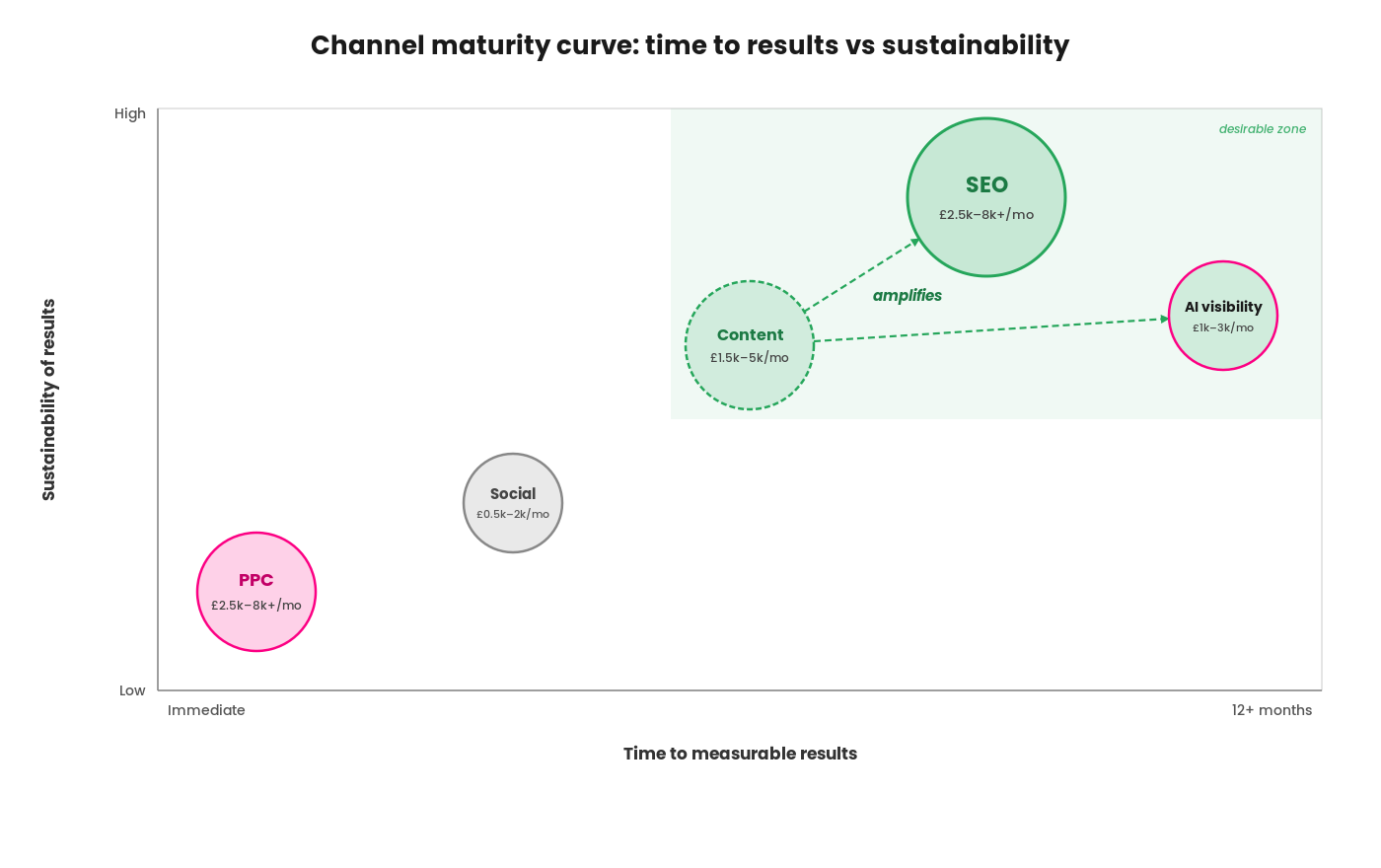
Five channels dominate the digital marketing landscape for UK law firms. Each has a distinct cost structure, timeline, and practice-area fit. The comparison table at the end of this section brings them together.
Is SEO still the highest-ROI channel for UK law firms?
Search engine optimisation (the practice of improving a website’s visibility in Google’s unpaid search results) remains the highest-return digital marketing channel for legal services. According to First Page Sage, a US-based SEO research firm that publishes ROI benchmarks from their client campaigns, legal services SEO has averaged 526% ROI over three years, with break-even at approximately 14 months.
The conversion data strengthens the case. First Page Sage’s analysis of 124 client campaigns between August 2022 and July 2024 found that SEO converts legal services visitors at 4.4%, compared with 2.2% for PPC — a two-to-one advantage. Those figures are drawn from US campaigns and direct UK equivalents have not yet been published, but the directional advantage of SEO over PPC for conversion rate holds consistently across the legal sector.
The caveat is time. SEO compounds: the returns in month 18 are substantially better than in month 6, but a firm expecting visible results in the first quarter will be disappointed. For a realistic picture of what to expect, we have published realistic SEO timelines by practice area that break down month-by-month signals for different practice areas.
SEO is best suited to firms with practice areas that generate strong informational search demand, including employment rights, family law, personal injury, and clinical negligence. Firms whose work is primarily referral-driven (corporate, high-value commercial) still benefit from SEO, but the ROI case is different and the timeline is longer.
Google AI Overviews are changing click-through dynamics for certain queries, with some searches now answered directly on the results page. This makes the evolving search funnel a factor in any 2026 SEO strategy, but it has not displaced the fundamental economics of organic search.
Does PPC work for UK law firms in 2026?
Pay-per-click advertising (paid listings at the top of Google search results, charged each time a user clicks) delivers immediate visibility but at a cost that varies enormously by practice area and geography.
UK-specific data from WhiteHat SEO (a UK digital agency specialising in legal sector PPC) and Wired Media (a UK PPC consultancy) puts personal injury click costs at £15–£50+ per click UK-wide, with London premiums of two to three times that range. According to WhiteHat SEO’s analysis, the average legal cost per lead from PPC sits at approximately £131 (a figure drawn from US benchmark data and cited in sterling-equivalent terms), driven by a roughly 5% click-to-lead conversion rate. At the extreme end, a London personal injury lead can cost £1,200 or more, compared with £400 in Birmingham or Manchester.
PPC works best for high-value practice areas where even a single signed matter justifies the acquisition cost: personal injury, clinical negligence, commercial litigation, and certain employment disputes. It is less effective for lower-value, higher-volume work where the cost-per-lead-to-fee ratio does not add up.
The main drawback of PPC is that results stop when spend stops. Unlike SEO, there is no compounding effect. A firm that pauses PPC at month six has no residual benefit at month seven. For firms using both channels, we have explored whether paid search affects organic performance and the answer is more nuanced than most agencies acknowledge.
What is AI visibility, and why does it matter for UK law firms?
AI visibility (the practice of ensuring a firm appears in answers generated by AI-powered search tools) is now a genuine strategic channel, not an extension of SEO. In our client work, the investment, timeline, and measurement framework for AI visibility differ enough from traditional SEO that treating it as a bolt-on undersells both disciplines.
Three distinct categories of AI search matter for UK law firms. Google AI Overviews are the AI-generated summaries that appear above traditional search results for certain queries. Google AI Mode is Google’s conversational search interface, currently in rollout. LLM answer engines (ChatGPT, Perplexity, Claude, Gemini) are standalone tools that prospective clients use independently of Google to research legal questions.
AI adoption across the legal sector is high: Clio’s 2026 UK & Ireland Legal Insights Report (published by the legal practice management firm in April 2026) found that 88% of UK and Ireland legal professionals are now using AI, but only 27% have embedded it deeply into daily workflows. The figures skew toward technology-engaged firms, but the gap between adoption and deep integration is the useful data: most firms are experimenting, not yet operating at scale.
The SRA’s Code of Conduct, particularly its requirements on supervision (Rule 3.5) and competence (Rule 3.2), means solicitors are professionally responsible for all published content, including AI-generated material. In practice, this means any AI-drafted marketing content should be reviewed by a qualified person before publication. The SRA’s December 2024 Warning Notice on marketing to members of the public sets out the broader framework for what constitutes compliant publicity, and the regulator has signalled a forthcoming GenAI FAQ and Good Practice Note that will likely address AI-specific obligations directly.
For firms wanting to understand how AI engines select which firms to recommend, we have published a detailed analysis: how AI search decides which firms to surface.
How does content marketing support law firm growth?
Content feeds both SEO and AI visibility. On its own it rarely drives enquiries, but it lifts the performance of every other channel. A well-structured practice area page improves organic rankings, gives AI engines material to cite, gives PPC campaigns better landing pages, and answers the questions prospective clients are asking before they pick up the phone.
Content works best for firms with practice areas that generate complex client questions: employment law (redundancy rights, TUPE transfers, tribunal processes), family law (divorce finances, child arrangement orders), and clinical negligence (medical negligence claims processes). For these practice areas, matching content to commercial search intent directly supports enquiry generation.
The caveat is that unfocused content actively harms SEO performance. Publishing two or three blog posts a week of thin, generic content dilutes site authority rather than building it. We have documented the hidden risks in unfocused law firm blogging in a separate article, and it is one of the most common issues we see across law firm websites. A structured content strategy built around topical depth across practice areas outperforms volume every time.
Does social media generate enquiries for UK law firms?
LinkedIn has a legitimate role in brand visibility, thought leadership, and recruitment for UK law firms. For B2B-focused practice areas (corporate, commercial, employment), a partner’s personal LinkedIn presence can reinforce the firm’s expertise and maintain referral network relationships.
For direct enquiry generation, social media rarely delivers measurable results for most law firms. The conversion path from a LinkedIn post to a signed instruction is too long and too indirect for firms that need to demonstrate marketing ROI to sceptical partners.
Traditional channels (events, sponsorships, legal directories, print advertising) still matter for relationship-driven practices, particularly at the senior end of the corporate market. They should not, however, dominate the digital marketing budget in 2026. The firms spending 40% of their marketing budget on directory listings and event sponsorships are typically the same firms struggling to demonstrate ROI.
How the channels compare in 2026
| Channel | Best suited practice areas | Typical UK cost range | Timeline to measurable results | ROI profile | Key risk |
| SEO | Employment, family, PI, clinical negligence | £2,500–£8,000+/month | 6–14 months to meaningful traffic; compounds over time | Highest long-term ROI (526% over 3 years per First Page Sage) | Requires sustained investment; results are not instant |
| PPC | PI, clinical negligence, commercial litigation | £15–£50+/click (UK); £130+/lead | Immediate visibility; results stop when spend stops | Variable; depends heavily on practice area and geography | High CPCs in competitive areas; no residual benefit |
| AI visibility | All practice areas (emerging) | Included in SEO/content scope or £1,000–£3,000/month standalone | 4–8 weeks for initial impressions; 3–6 months for citations to stabilise | Emerging; long-term brand and referral value | Rapidly evolving; measurement frameworks still maturing |
| Content marketing | Employment, family, clinical negligence, PI | £1,500–£5,000/month (content production) | 3–6 months for SEO impact; immediate for PPC landing pages | Amplifies the returns of other channels | Unfocused content actively harms SEO |
| Social media | Corporate, commercial, employment (LinkedIn) | £500–£2,000/month (management) | 3–6 months for brand visibility | Low direct ROI for enquiry generation | Time cost with limited measurable enquiry return |
Cost ranges are indicative and vary by firm size, geography, and competitive intensity. SEO and PPC ranges reflect UK market data from WhiteHat SEO and Wired Media. Competitive keyword CPCs in practice may significantly exceed the ranges shown — for example, “personal injury lawyer” can exceed £90 per click for high-competition terms.
3. Which marketing channels suit each legal practice area?
A personal injury firm and a corporate law firm operate in fundamentally different markets. Their prospective clients search differently, make decisions differently, and evaluate firms differently. The channel mix should reflect this.
In our client work across multiple practice areas, the pattern we see repeatedly is that firms following generic marketing advice waste budget on channels that do not match their buyer journey. The matrix below captures the channel recommendations we make most often, practice area by practice area.
Personal injury and clinical negligence
Personal injury generates some of the highest PPC costs in UK legal marketing (£15–£50+ per click, rising sharply in London), but case values are high enough to justify the spend for firms with strong intake processes. SEO is critical for the informational queries that precede a claim (“can I claim for a workplace injury”, “medical negligence time limits”), and AI visibility matters increasingly because prospective claimants research through AI tools before contacting a firm.
The SRA’s restrictions on PI advertising add a compliance layer that other practice areas do not face to the same degree. Any marketing activity must align with the SRA’s Warning Notice on marketing to members of the public, which covers misleading claims, testimonials, and fee transparency.
Employment law
Employment law has strong informational search demand. People facing redundancy, unfair dismissal, or discrimination search extensively before instructing a solicitor, making SEO and content the primary channels. PPC can work for urgent, high-intent queries (“unfair dismissal solicitor near me”), but search volumes for paid terms tend to be lower than in PI.
Content does more to support every other channel in employment law than in most practice areas. A comprehensive guide to redundancy rights or TUPE transfer processes serves both organic search and AI visibility, and positions the firm as the authoritative source prospective clients find first.
Family law
Family law involves a highly emotional buyer journey. Prospective clients search for information and reassurance before they search for a solicitor. Content and SEO are the primary channels for reaching people at the research stage (“how does divorce financial settlement work”, “child arrangement order process”). PPC captures urgent needs (“divorce solicitor near me”). Social media, particularly through a partner’s personal presence, can play a supporting role in building trust.
Corporate and commercial
Corporate and commercial work is overwhelmingly referral-driven. SEO matters for brand visibility and validation (when a referral recipient searches the firm, what they find shapes their confidence), but the buyer journey is longer and more relationship-dependent than consumer-facing practice areas. Content positions the firm’s expertise for the moments when a prospective client or referrer evaluates them online.
Conveyancing
Conveyancing is price-competitive. Prospective clients compare quotes and use comparison tools, making PPC and local SEO the primary channels. Content plays a smaller role because the buyer journey is typically shorter and more transactional. Margin pressure (the gap between acquisition cost and fee income) makes the ROI calculation critical. A conveyancing firm paying £30 per click for a £800 transaction needs sharp conversion tracking.
Practice-area channel mix matrix
| Practice area | SEO | PPC | AI visibility | Content | Social media |
| Personal injury / clinical negligence | Primary | Primary (high cost, high value) | Growing | Supporting | Limited |
| Employment law | Primary | Supporting (lower volume) | Growing | Primary | Limited |
| Family law | Primary | Supporting (urgent queries) | Growing | Primary | Supporting |
| Corporate / commercial | Supporting (validation) | Limited | Supporting | Supporting (expertise positioning) | Supporting (LinkedIn) |
| Conveyancing | Primary (local) | Primary (competitive) | Limited | Limited | Limited |
Primary = should be a core budget line. Supporting = adds value but is not the lead acquisition channel. Limited = minimal direct enquiry impact for most firms. Growing = emerging channel with increasing relevance.
Find out which channels the data supports for your firm
Book a free 30-minute channel strategy call with a senior Crescat strategist. We’ll review your current marketing spend against the benchmarks in this article, assess which channels are likely to deliver the best return for your practice areas, and give you a recommended priority order for the next 90 days.
4. Which law firm marketing tactics have stopped working in 2026?
Part of a credible marketing strategy is knowing when to stop doing something. Four tactics that were standard practice as recently as 2023 have lost enough effectiveness that firms still investing in them should reassess.
| Tactic | Why it used to work | What changed | What to do instead |
| Unfocused blogging | More pages meant more chances to rank | Google’s 2024–2025 updates penalise thin, undifferentiated content and reward topical depth | Publish one well-researched, practice-area-specific article per month instead of four generic posts per week |
| Directory-heavy link building | Volume of directory submissions increased domain authority scores | Google’s link evaluation shifted toward quality and relevance over quantity | Focus on links from respected legal publications, local business organisations, and genuine professional associations |
| Generic social media | Cross-posting built presence across platforms with minimal effort | Platform algorithms now reward platform-specific content; generic cross-posting generates no measurable enquiry return | Build a specific presence on one platform (LinkedIn for B2B, Instagram for brand) rather than spreading thinly |
| Set-and-forget PPC | Initial campaign setup delivered results without ongoing adjustment | Competitor behaviour, seasonality, and Quality Score changes erode performance over time | Review and adjust campaigns monthly; update negative keyword lists, test ad copy, and align landing pages to searcher intent |
Unfocused blogging
Publishing two or three blog posts a week used to be standard SEO advice. The logic was simple: more pages meant more chances to rank. That logic no longer holds. Google’s algorithm updates in 2024 and 2025 penalise sites with high volumes of thin, undifferentiated content, and reward sites that demonstrate topical depth through fewer, better pages.
The firms we work with that have shifted from volume to structure, publishing one well-researched, practice-area-specific article per month instead of four generic posts per week, typically see better organic performance within two quarters. We have written in detail about the hidden risks in unfocused law firm blogging, and it remains one of the most common issues we see across law firm websites.
Directory-heavy link building
Submitting a firm’s details to 50 online directories used to move the needle on domain authority (a third-party score estimating a site’s competitive strength). It no longer does. Google’s approach to link evaluation has shifted toward quality and relevance. A handful of links from respected legal publications, local business organisations, and genuine professional associations carry more weight than dozens of directory entries.
Directory listings still have a role in the foundation layer, particularly for local SEO and for maintaining consistent NAP data (name, address, phone number — the basic contact details search engines use to verify a business). They should not be the centrepiece of a link building strategy.
Generic social media
Posting the same content across LinkedIn, Facebook, X, and Instagram without a platform-specific strategy is a time cost with no measurable return in enquiries for most law firms. The firms that get value from social media in 2026 are doing something specific: a senior partner building a genuine thought leadership presence on LinkedIn, or a family law team using Instagram to humanise the firm’s brand. Posting press releases across four platforms is not that.
Set-and-forget PPC
Running the same PPC campaigns for six months without adjusting for seasonality, competitor behaviour, or Quality Score changes (Google’s rating of how relevant and useful an ad and its landing page are to the searcher) wastes budget steadily. PPC requires active management. Negative keyword lists need updating, ad copy needs testing, and landing pages need to match the searcher’s intent. In our client work, we typically see firms that review and adjust campaigns monthly outperform those on quarterly review cycles by a meaningful margin.
5. How do digital marketing channels work together?
Most marketing guides treat each channel as independent. In practice, the channels interact, and the interaction is where the real performance gains appear.
The most common interaction we see across law firm clients runs like this: PPC data reveals which keywords actually convert into enquiries (not just which keywords get clicks), and that conversion data shapes the SEO content strategy. A firm running PPC for employment law discovers that “constructive dismissal solicitor” converts at three times the rate of “employment lawyer near me”. The SEO team then builds topical depth around constructive dismissal, producing detailed practice-area content that ranks organically and feeds AI visibility.
The loop runs in the other direction too. As SEO builds organic traffic and the firm’s content base grows, the firm becomes less dependent on PPC spend for baseline visibility. PPC shifts from a primary acquisition channel to a supplement that targets specific high-value terms or seasonal demand.
Content structured for AI visibility also lifts organic SEO performance: answer-first formatting, clear definitions, and structured data benefit both channels at once. The brand recognition that comes from appearing in AI-generated answers also lifts PPC click-through rates — a searcher who has already seen the firm’s name in an AI answer is more likely to click its paid ad.
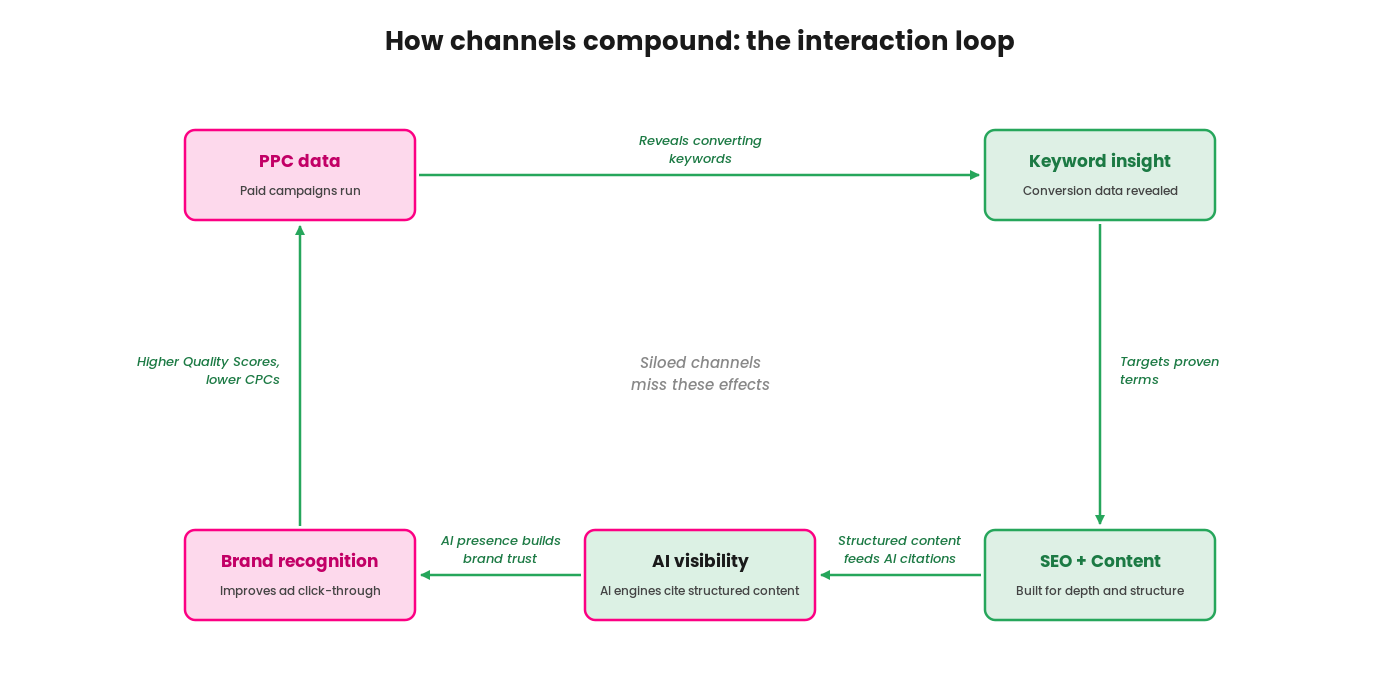
This compounding effect is one of the strongest reasons for working with a single agency or integrated team across channels, rather than splitting SEO, PPC, and content across separate providers who don’t share data or strategy.
6. How should a UK law firm build a 2026 marketing plan?
The landscape is clear. The question is what to do about it. The following five-step framework provides a starting point for any UK law firm reviewing its digital marketing approach.
Five steps to build your 2026 digital marketing plan
- Audit your current spend and results. Map where every pound of marketing budget goes and what it produces. If you cannot connect a channel to a specific number of enquiries or signed matters, that channel needs scrutiny — as does whether the work is better delivered by an in-house hire or a specialist agency.
- Identify your primary practice area and firm size band. Use the practice-area channel mix matrix in Section 3 to match your firm’s profile to the recommended channel emphasis.
- Concentrate on two or three channels. Spreading budget across five or six channels rarely produces measurable results in any single one. Pick the channels that match your practice areas and invest enough to move the needle.
- Set 90-day review milestones. Every channel should have clear performance indicators reviewed on a 90-day cycle. For a practical framework on what this looks like, see our guide to what a serious 90-day SEO pilot looks like.
- Audit your AI search presence. Check how your firm appears in Google AI Overviews, Google AI Mode, and LLM answer engines for your core practice areas. If you are invisible, this is a gap that will widen. Our AI search visibility services can help you assess and address it.
A forthcoming article on marketing budget benchmarks for UK law firms will provide more detailed budget allocation guidance by firm size and practice area. We will link it here when it is published.
7. Frequently asked questions
How much should a UK law firm spend on digital marketing in 2026?
The average UK professional services firm (including law firms) spends 3.1% of turnover on marketing and business development, according to the Law Firm Marketing Club’s 2025 survey. The broader range sits between 2% and 10% of revenue. Firms in growth mode or competing in high-CPC practice areas like personal injury tend toward the higher end. The more important question is allocation: a £60,000 budget concentrated on two channels typically outperforms £100,000 spread across six.
Is SEO still worth it for law firms with AI search changing results?
Yes. SEO remains the highest-ROI digital channel for legal services, with published benchmarks suggesting 526% returns over three years. AI Overviews are changing click dynamics for some queries, but the firms ranking well organically are also the firms most likely to be cited in AI-generated answers. The two channels reinforce each other rather than competing.
What marketing channels work best for personal injury law firms?
Personal injury firms benefit most from a combination of SEO and PPC. SEO captures the informational queries that precede a claim; PPC provides immediate visibility for high-intent searches. AI visibility is growing in importance. PPC costs are among the highest in UK legal marketing (£15–£50+ per click), but case values justify the investment for firms with strong intake processes.
How long does it take to see results from law firm SEO?
Break-even from SEO investment typically occurs at around 14 months, with meaningful traffic improvements visible from month six. Results compound over time, making the second year substantially more productive than the first. For a detailed breakdown by practice area, see our guide to realistic SEO timelines by practice area.
Should law firms invest in AI search optimisation?
Firms that want to appear in AI-generated answers for their practice areas should treat AI visibility as a distinct workstream. The SRA’s existing requirements on supervision and competence (Rules 3.5 and 3.2) mean solicitors are responsible for all published content, including AI-generated material — so compliance must be part of the approach. Investment now positions a firm for a channel that will carry increasing weight in how prospective clients discover and evaluate solicitors.
What is the difference between SEO and PPC for law firms?
SEO builds organic visibility over months and compounds over time — traffic continues and grows even without ongoing spend at the same level. PPC delivers immediate visibility but stops the moment spend stops. SEO converts legal services visitors at roughly twice the rate of PPC, according to First Page Sage data (4.4% vs 2.2%). Most firms benefit from both, with the balance depending on practice area, budget, and timeline expectations.
What’s the right marketing mix for your firm?
The digital marketing landscape for UK law firms in 2026 is more complex than it was even two years ago. AI search has arrived as a genuine channel. PPC costs continue to rise. The gap between firms investing strategically and firms spreading budget across everything has widened.
The right approach depends on your firm’s specific situation: your practice areas, your firm size, your competitive environment, and your starting position. A personal injury firm in London faces a fundamentally different marketing challenge from an employment law practice in Leeds or a corporate firm in Bristol.
Some of what you are currently doing may need to stop. Unfocused blogging, directory-heavy link building, and unmanaged PPC campaigns are consuming budget that could deliver measurably better results elsewhere. Some of what you are not doing, particularly around AI visibility, needs to start.
The firms that will win market share in 2026 are the ones making these decisions with data, not habit. They are auditing their channels, concentrating their budgets, and reviewing results on 90-day cycles. They treat marketing as an investment with measurable returns, not as a cost to be minimised.
If you are wondering how this applies to your firm specifically, that is the question worth sitting with. The right channel mix depends on your practice areas, your size, and your market — and that conversation is better had with your own numbers in front of you.
Get a channel strategy specific to your firm
Book a free 30-minute call with a senior Crescat strategist. We’ll review your current marketing spend, match it against the practice-area and firm-size benchmarks in this article, and tell you which channels we’d prioritise and why, with a realistic timeline for results.
- A review of your current channel mix against the benchmarks in this article
- Practice-area-specific recommendations based on the data
- A recommended priority order for the next 90 days
Sources
- Law Firm Marketing Club, Professional Services Marketing Survey 2025 — UK professional services marketing spend benchmarks including law firms (3.1% of turnover; 66% reported increased turnover)
- First Page Sage, SEO vs PPC Statistics (124 client campaigns, Aug 2022–Jul 2024) — Legal services SEO conversion rate 4.4% vs PPC 2.2%. US vendor proprietary client data
- First Page Sage, SEO ROI Statistics (Q1 2021–Q3 2025) — Legal services SEO ROI (526% over three years; 14-month break-even). US vendor proprietary client data
- WhiteHat SEO, Law Firm Google Ads & PPC (2025) — UK PPC cost benchmarks (£15–£50+ CPC for PI; £131.63 average legal CPL — note: CPL figure drawn from US benchmark data cited in sterling-equivalent terms; geographic variation data)
- Wired Media, Solicitors’ PPC Campaigns (2025) — UK PPC cost corroboration
- Clio UK, 2026 UK & Ireland Legal Insights Report (April 2026) — AI adoption survey (88% of UK and Ireland legal professionals using AI; 27% with deep daily integration)
- SRA, Code of Conduct for Solicitors, Rules 3.2, 3.5, and 8.8 — Competence, supervision, and regulatory requirements for law firm publicity
- SRA, Warning Notice: Marketing to Members of the Public (December 2024) — SRA guidance on law firm advertising and marketing compliance
- SRA, forthcoming GenAI FAQ and Good Practice Note — signalled February 2026 via SAL/SRA webinar