In-house vs specialist agency for law firm SEO: a total cost, risk and control comparison
14 June 2026 · Nigel Brown

Last reviewed by: Lee Thomas, Managing Director, Crescat Digital — 9 June 2026
Most firms start this decision with two numbers: the salary they would pay an in-house SEO hire, and the monthly retainer an agency has quoted. The salary usually looks like the cheaper option. It rarely is.
That gap between what a hire appears to cost and what it costs has widened. Since April 2025, employing anyone in the UK costs more. Employer’s National Insurance rose and the threshold at which it starts dropped sharply. A salary figure on a job advert is now further from the real annual cost than it was a year ago.
This article gives you a UK-specific way to compare the two options (and the hybrid middle ground most firms overlook) on the three things that decide it: total cost, risk, and control. It is written for the person who will either line-manage the hire or sign the retainer, and who will have to defend the choice to partners. The honest answer is not always “use an agency”, and where in-house genuinely wins, this article says so.
There is a reason the question matters now. SEO is the most outsourced marketing service among UK law firms, at around 60% according to the Law Firm Marketing Club’s Professional Services Marketing Survey of UK firms. Despite marketing budgets rising into 2026, in-house marketing teams have barely grown; the same survey puts the average law firm marketing team at around three people. Firms are directing the extra money to external support rather than new headcount. Before you follow that pattern or break from it, it helps to see the full comparison.
Key takeaways
- The real choice is total cost of ownership versus retainer, not salary versus retainer. A base salary is only part of what an in-house hire costs.
- Fully loaded, a UK in-house SEO hire costs well above the headline salary. Once employer’s National Insurance, pension, tools, recruitment, and management time are added, the real figure is often around 40% higher.
- One hire rarely covers the whole job. SEO spans technical, content, links and digital PR, local, and AI search, and few people are strong across all five.
- Risk and ramp time matter as much as cost. A new hire spends months getting up to speed, and if they leave, the knowledge and momentum leave with them.
- For most firms below a clear maturity threshold, an agency or hybrid model carries lower total cost and lower risk. In-house wins above that threshold, and a hybrid suits many mid-market firms best.
Table of contents
1. Why “it’s cheaper to hire someone” is the wrong question
2. What does an in-house SEO hire really cost?
3. What does a law firm SEO agency cost?
4. Control: what you really gain and lose with each model
5. Ramp time and risk: the costs that don’t show on the invoice
6. When in-house actually wins
7. The hybrid model: in-house coordinator plus specialist agency
1. Why “it’s cheaper to hire someone” is the wrong question
The salary-versus-retainer comparison is the wrong sum, and it leads firms to the wrong answer. A £40,000 salary looks cheaper than a £4,000-a-month retainer (£48,000 a year) until you add everything else employing someone involves, and until you ask whether one person can actually do the whole job.
A better comparison runs on three axes. The first is total cost of ownership: the full annual cost of a function, including the indirect and hidden costs, not just the headline price. The second is risk: what happens if the hire underperforms, leaves, or simply cannot cover every part of SEO. The third is control, the thing firms believe they gain by hiring in-house, which is worth examining honestly rather than assuming.
There is also a false choice hiding in the question. It is not only “hire one person” or “hand everything to an agency”. A hybrid model, an in-house coordinator working alongside a specialist agency, is a real third option, and for a lot of mid-market firms it is the right one. We will come to it. For deciding how this resourcing question fits alongside your wider spend, it sits next to the separate question of how to split a budget across channels.
The three questions that decide it, and the one that doesn’t
The question that doesn’t decide it: is the salary lower than the retainer?
The three that do: What does each option really cost, fully loaded? What is the risk if it goes wrong? And how much control do you genuinely gain or lose?
2. What does an in-house SEO hire really cost?
A salary is the start of the cost, not the whole of it. Once you add the costs that come with any employee, the fully loaded cost of an in-house SEO hire lands well above the figure on the job advert.
What you pay for an in-house hire
Start with the base salary. UK salary data for 2025 puts a mid-level in-house SEO (manager level) at roughly £40,000–£52,000 nationally, with London materially higher, where senior or specialist manager roles can reach £65,000–£70,000. A more junior SEO executive sits around £26,000–£35,000; a senior or lead specialist £45,000–£65,000 and up. These are indicative ranges drawn from aggregated UK salary data rather than a single source, and they vary by region and firm.
On top of the salary come the on-costs, the employer’s contributions and overheads that the salary figure hides:
- Employer’s National Insurance: Since 6 April 2025, employers pay National Insurance at 15% on earnings above a £5,000 threshold (the rate rose from 13.8% and the threshold fell from £9,100 in the same change). On a £42,000 salary that is around £5,550 a year. The Employment Allowance (£10,500 for 2025/26, with the previous £100,000 eligibility cap removed) offsets a firm’s total employer National Insurance bill, so whether a new hire is cushioned by it depends on how much of the allowance the firm’s existing payroll has already used. For most mid-sized firms the allowance is exhausted well before an additional hire, so that hire carries close to the full charge; a smaller firm with allowance still to spare may pay less.
- Auto-enrolment pension: Under workplace pension rules (auto-enrolment is the duty on employers to enrol eligible staff into a pension and contribute), the employer minimum is 3% of qualifying earnings, on a 2025/26 band of £6,240 to £50,270. That is about £1,075 a year on a £42,000 salary. Many firms contribute more than the floor.
- Tools: A competent in-house function needs more than one tool: an all-in-one SEO platform, plus a technical crawler, rank tracking, and analytics. A realistic toolstack runs around £3,000–£6,000 a year (the major platforms list at roughly £200 a month before you add the rest). The agency carries this cost in a retainer; in-house, it is yours.
- Recruitment: Hiring through an agency typically costs 15–25% of first-year salary, more for specialist roles. On a £42,000 hire at 20%, that is around £8,400. It is a one-off, but a real cost to spread across the hire’s expected tenure.
- Management and overhead: A partner or marketing director’s time to manage the hire, plus equipment, training, and software. Treat it as an allowance rather than a precise figure, but it is not zero.
Put together, a £42,000 hire costs roughly £59,000–£60,000 a year fully loaded, about 40% above the headline salary. That is the number to compare against a retainer, and it is the number our Total Cost Calculator lets you build for your own figures.
| In-house SEO hire (£42,000 base) | Indicative annual cost |
| Base salary | £42,000 |
| Employer’s National Insurance (15% above £5,000) | £5,550 |
| Auto-enrolment pension (employer minimum) | £1,075 |
| Tools (SEO platform, crawler, rank tracking) | £4,000 |
| Recruitment (amortised) | £2,800 |
| Management and overhead allowance | £4,000 |
| Fully loaded annual cost | ~£59,400 |
Figures are indicative, drawn from aggregated UK salary data, current HMRC and pension rates, and published tool pricing, not a single primary source. Your numbers will differ by seniority, region, and firm.
Can one person actually do the whole job?
The bigger problem with a single hire is not the cost. It is the single-hire skill gap. SEO is not one skill. It spans technical SEO (site health, crawling, indexing, structured data), content strategy and production, link building and digital PR, local SEO, and now AI search visibility. That last one means getting the firm surfaced in tools like Google’s AI Overviews and ChatGPT, and it behaves as its own discipline. Few people are strong across all five.
The pattern we see when a firm runs SEO on one hire is that the work narrows to that person’s strengths. A content-focused hire produces good articles while the technical foundations and the link profile drift. A technical hire keeps the site healthy while the content that builds topical authority, the depth across practice areas that earns rankings, goes unwritten. The firm is then left with three options, each with a catch:
- Accept the gaps, and leave whole areas of SEO under-served.
- Hire a second specialist, and double the costs above.
- Buy in freelancers piecemeal, which reintroduces the external dependency the firm hired to avoid.
3. What does a law firm SEO agency cost?
A retainer buys the whole skill set for a single monthly figure with none of the on-costs. Where a hire gives you one person’s subset of SEO, an agency gives you technical, content, links, local, and AI search from a team, plus the toolstack, senior strategy, and cover for holiday and sickness, none of which appears as a separate line on your books.
For properly scoped law firm SEO, UK retainers run from around £2,500 to £15,000+ a month, with a typical mid-market band of £3,000–£6,000, the range we set out in detail in what a serious 90-day pilot should look like. These are indicative ranges, not a fixed price list. The point for this comparison is what the retainer does not carry:
- No employer’s National Insurance or pension.
- No recruitment fee.
- No tooling bill.
- No holiday or sick cover to arrange.
- No management overhead beyond the time to brief and review the work.
Set against the in-house figure, the comparison sharpens. A £42,000 hire costs roughly £59,000 fully loaded and covers one person’s slice of the work. A mid-market retainer in the £3,000–£6,000 band costs £36,000–£72,000 a year and covers all of it. The fully loaded hire sits inside the agency range, for a fraction of the capability.
To be fair to the in-house case, a retainer is not all upside. You give up a dedicated full-time presence in the building and the sense of directly owning the function. Whether that loss is real or mostly felt is the control question, and it is worth taking seriously rather than waving away. The case for outsourcing specialist work rests on it.
Run your own numbers
Want the fully loaded comparison for your firm? Download our Law Firm SEO Total Cost Calculator. Plug in a prospective salary and see the real annual cost (salary, employer’s National Insurance, pension, tools, recruitment, and management time) set side by side with an equivalent agency retainer and a hybrid option. It takes about five minutes and the figures are yours to take to your finance partner.
4. Control: what you really gain and lose with each model
Control is the axis firms most over-weight in favour of hiring, so it is worth separating what is real from what is assumed. The instinct is reasonable: someone in the building reports to you, answers immediately, and learns the firm inside out. Some of that is a genuine advantage. Some of it is less solid than it feels.
What you genuinely gain in-house is institutional knowledge and immediate availability: a person who absorbs how the firm works and is there when you need them. What you also get, and tend not to price in, is a single point of capacity and a single range of skills. The responsiveness is real, but it is bottlenecked through one person who can only do the parts of SEO they are good at.
A well-run agency relationship delivers most of the control benefit through structure rather than proximity: a defined scope, an agreed reporting cadence, a named account lead you can hold to account, and your own oversight of the priorities, without the firm carrying the employment risk. The difference between a black-box agency and a controlled one is not whether the team sits in your office; it is whether the engagement is properly scoped and reported.
| Control: the assumption | Control: the reality |
| A hire gives you total command of SEO | You command one person’s time and one person’s skill range |
| In-house means instant turnaround on everything | Turnaround is fast but capped by a single person’s capacity |
| An agency is a black box you can’t direct | A scoped, reported engagement gives you oversight without the headcount risk |
| Someone in the building “just gets” the firm | True, and genuinely valuable for fast, firm-specific content |
There is a legitimate in-house control advantage, and it feeds the decision later in this article: for firms with a high, constant flow of firm-specific content, such as a busy litigation practice or a news-driven commercial team, a colleague in the building can move on internal context faster than any external partner. That is real, and it is worth naming.
5. Ramp time and risk: the costs that don’t show on the invoice
Two costs never appear on the invoice and rarely appear in the comparison: the months a new hire takes to become productive, and the risk the firm carries if a single specialist is the whole function.
Ramp time: the months before a hire produces
Ramp time is the gap between a hire’s start date and the point they produce work that moves results, and it is salary paid for limited output. A new in-house hire must learn the firm, its practice areas, and its existing site, set up the toolstack, and build a plan before the work starts paying back. UK hiring alone now takes around six to twelve weeks from advert to accepted offer in current conditions, with specialist roles at the longer end, and that is before the first day, let alone the first results.
An established specialist agency that already knows the legal sector starts producing sooner, because the sector knowledge, the tools, and the process are already in place. The practical effect is that the firm reaches its first meaningful results faster, which matters, because SEO already asks for patience. We set out realistic timelines in how long law firm SEO takes to show results; adding a hire’s ramp on top of that timeline pushes the payback further out.
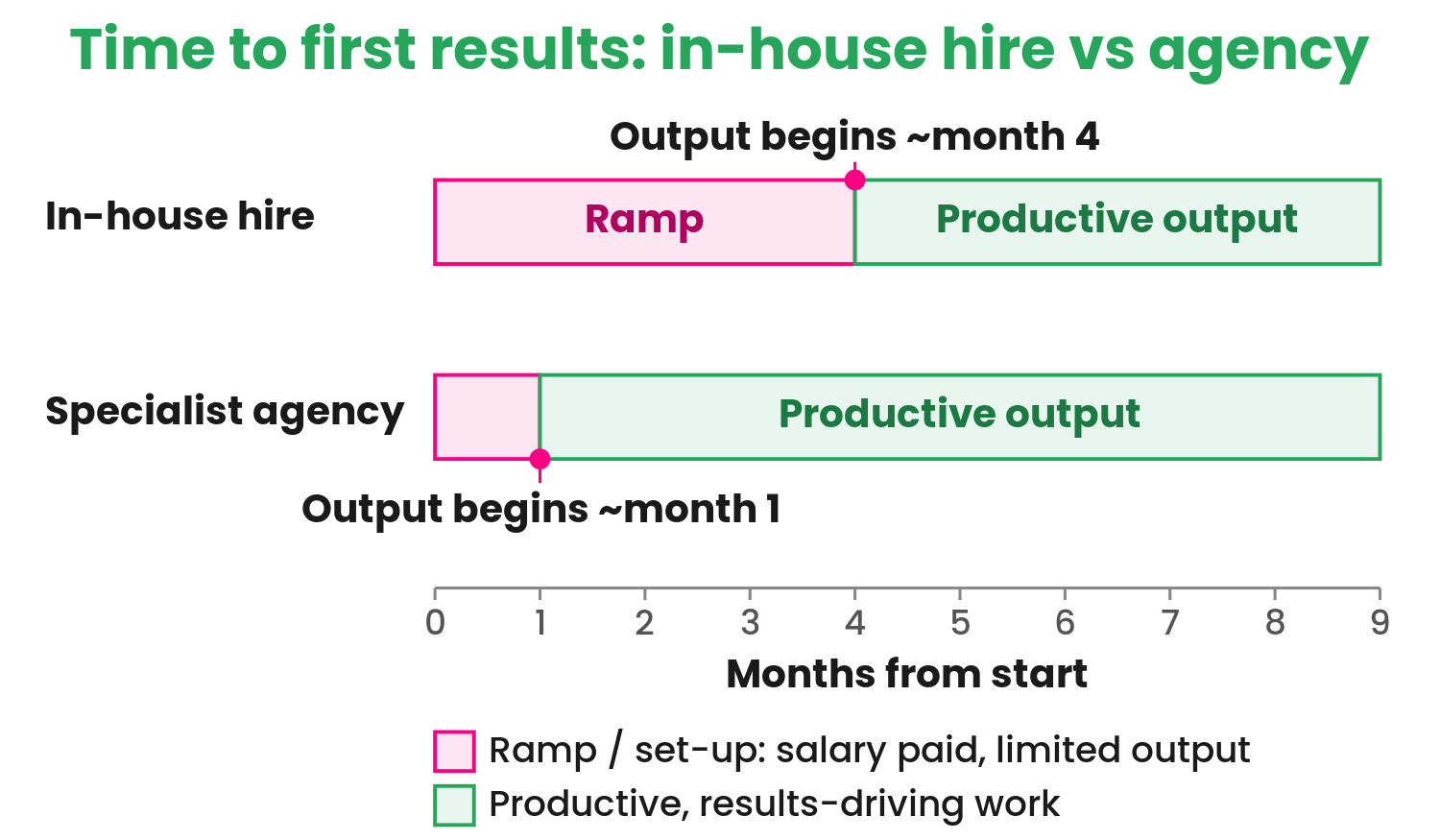
Risk: key-person dependency and the skill gap
The single biggest risk of a one-person function is key-person dependency: the firm’s entire SEO capability resting on one individual. If they leave, the institutional knowledge goes with them, the work stalls, and the recruitment cost and ramp time reset from zero. An agency spreads that risk across a team; no single departure stops the work.
Two related risks sit alongside it. The skill-gap risk from Section 2 is also a risk in the strict sense: whole areas of SEO left under-served because they fall outside one person’s strengths, with the firm often unaware of what is being missed. And continuity risk is mundane but real: holiday, sickness, and parental leave each stop a function of one entirely, where an agency has cover built in.
6. When in-house actually wins
In-house genuinely wins for some firms, and a comparison that pretended otherwise would not be worth reading. The conditions are specific, and they are about whether a firm can keep a full SEO capability busy, well-managed, and complete.
Building in-house tends to be the right call when a firm has enough scale and budget to hire more than one specialist, so the skill set is actually covered rather than narrowed to one person; a mature in-house marketing function that can direct and manage the work, rather than a partner managing an SEO hire as a side duty; a high, sustained volume of SEO and content work that keeps a full-time hire fully utilised; and the growth ambition to justify owning the capability for the long term.
The honest test is utilisation and coverage. If a firm cannot keep a complete SEO skill set busy and properly managed in-house, a single hire will under-deliver and an agency or hybrid will cost less for more. Most firms that are not clearly above this threshold are best served by the hybrid model, which is the next section.
You are probably ready to build in-house if:
- You can fund more than one specialist, so technical, content, links, local, and AI search are all genuinely covered.
- You already have a marketing function that can manage and direct SEO work day to day.
- You have enough constant SEO and content work to keep full-time people fully occupied.
- You want to own the capability long term, not just solve an immediate visibility problem.
7. The hybrid model: in-house coordinator plus specialist agency
For many mid-market firms the right answer is neither pure in-house nor pure agency, but a hybrid: an in-house marketing person who owns firm context and coordination, working alongside a specialist agency that supplies the full skill set and senior strategy. It keeps the part of in-house control that genuinely matters without asking one hire to be a five-discipline specialist.
The split of responsibilities is the heart of it. The in-house coordinator owns internal context, stakeholder management, and quick-turnaround firm-specific content, the things that benefit from someone in the building. The agency owns the specialist disciplines: technical SEO, links and digital PR, AI search, strategy, and the toolstack. Each side does what it is best placed to do.
| The in-house coordinator owns | The specialist agency owns |
| Internal context and stakeholder management | Technical SEO and site health |
| Fast, firm-specific content and updates | Content strategy and topical-authority planning |
| Briefing the agency and reviewing outputs | Link building and digital PR |
| Day-to-day marketing coordination | AI search visibility and ongoing monitoring |
| Knowing the firm’s people and priorities | Senior strategy, reporting, and the toolstack |
On cost, the hybrid often uses a role the firm already has, such as a marketing manager or coordinator, alongside a leaner retainer than a full-service one, because the agency is not carrying the coordination layer. It suits firms with some marketing maturity but not enough sustained SEO volume to justify building a full in-house team. A hybrid engagement can start from a properly scoped 90-day pilot, with the split of responsibilities agreed at the outset.
| Total cost of ownership | In-house hire | Specialist agency | Hybrid |
| Fully loaded annual cost | ~£59,000 (one mid-level hire) | £36,000–£72,000 (mid-market retainer) | Existing coordinator + leaner retainer |
| Skill-set coverage | One person’s subset | Full team: technical, content, links, local, AI search | Full set, split across both |
| Employer on-costs (NI, pension) | Yes, on top of salary | None | Only on the in-house portion |
| Tooling | Firm pays (~£3,000–£6,000/yr) | Included in retainer | Included in retainer |
| Holiday and sick cover | None; the function stops | Built in | Agency side covered |
| Ramp time | Months before productive | Faster, sector and tools already in place | Faster on the agency side |
| Key-person risk | High, one point of failure | Low, spread across a team | Lower, agency backstops the coordinator |
8. A decision framework: which model fits your firm
The right model follows from a handful of facts about your firm: its size and fee-earner count, the maturity of its marketing function, the sustained volume of SEO and content work, growth ambition, and appetite for employment risk. Map those honestly and the answer usually falls out.
As a starting point, the three models map roughly like this:
- Specialist agency suits smaller firms and those with limited in-house marketing, who need the full skill set without building and managing a team.
- Hybrid suits mid-market firms with some marketing maturity but not enough sustained SEO volume to justify a full in-house team. The coordinator owns context, the agency owns the specialisms.
- In-house (or in-house-led) suits larger firms with a mature marketing function, a constant volume of work, and the ambition to own the capability long term, with the budget to hire more than one specialist.
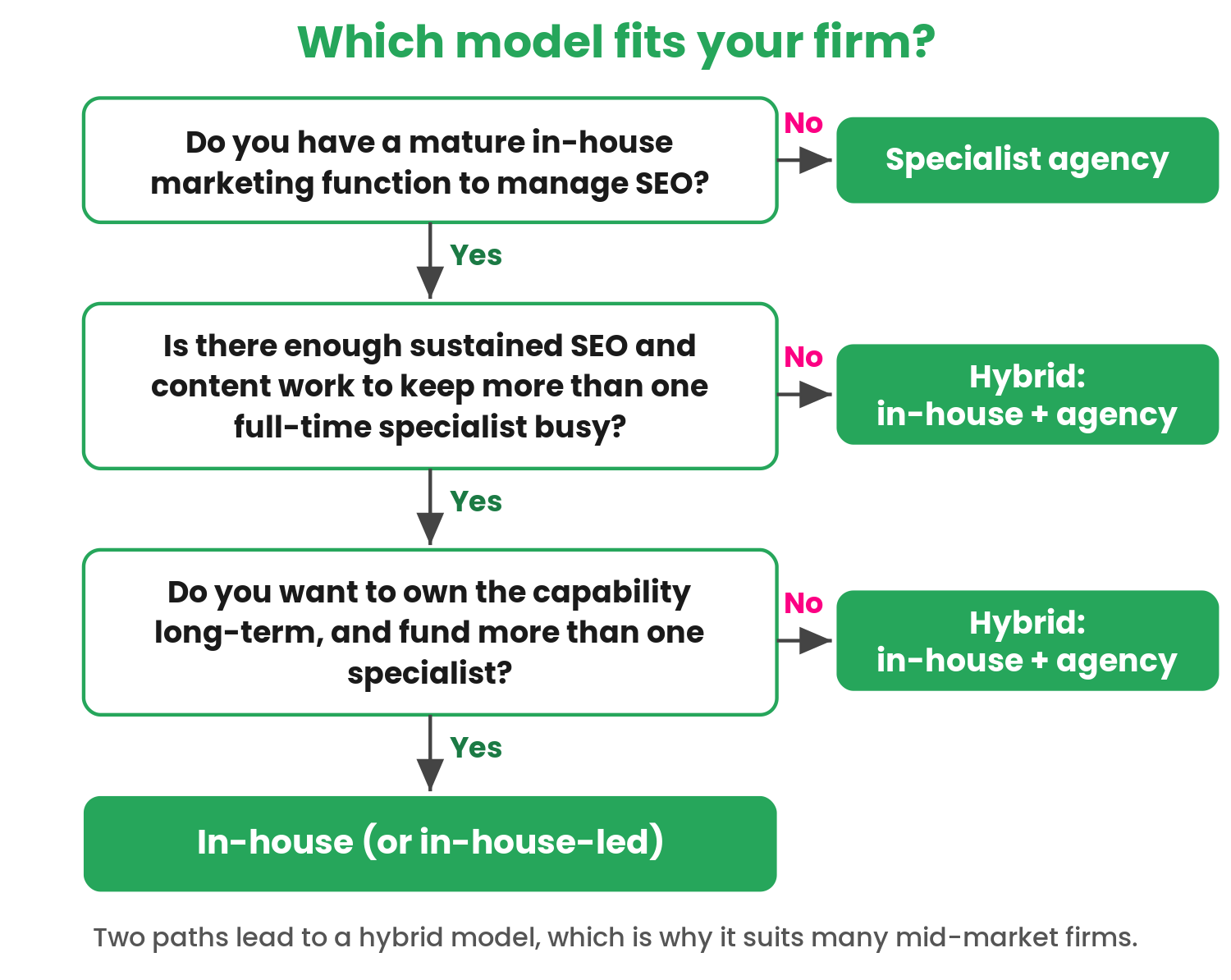
A starting point, not a verdict; the right model depends on your firm’s specific size, maturity, and ambition.
The framework gets you to a sensible default. Turning it into a recommendation for your firm means running your own numbers and pressure-testing the answer against your situation, which is what the calculator and a short call are for. You can also see examples of our law firm work to gauge the kind of engagement that fits.
9. Frequently asked questions
Is it cheaper to do SEO in-house or use an agency?
For most firms, an agency or hybrid works out cheaper once you compare like for like. A single in-house hire’s fully loaded cost (salary plus employer’s National Insurance, pension, tools, recruitment, and management time) typically runs around 40% above the headline salary and still only covers part of the work, where a retainer covers the whole skill set with no on-costs.
How much does it cost to hire an in-house SEO in the UK?
More than the salary. A mid-level in-house SEO on a £42,000 base costs roughly £59,000 a year fully loaded once you add employer’s National Insurance (15% above £5,000 since April 2025), the auto-enrolment pension minimum, a £3,000–£6,000 toolstack, recruitment, and management time. Senior or London hires cost considerably more.
What does a law firm SEO agency cost per month?
Properly scoped UK law firm SEO retainers run from around £2,500 to £15,000+ a month, with a typical mid-market band of £3,000–£6,000. The figure covers the full skill set, the toolstack, and senior strategy, with none of the employer on-costs, recruitment, or cover that an in-house hire carries. These are indicative ranges rather than a fixed price.
When should a law firm bring SEO in-house?
When it can keep a full SEO skill set busy, covered, and well-managed. That usually means a larger firm with a mature marketing function, a sustained high volume of SEO and content work, the budget to hire more than one specialist, and the ambition to own the capability long term. Below that threshold, a single hire tends to under-deliver.
Can one in-house hire cover all of a law firm’s SEO needs?
Rarely. SEO spans technical, content, link building and digital PR, local, and AI search, and few people are strong across all five. A single hire usually narrows the work to their own strengths, leaving the other areas under-served, which is why firms either accept gaps, hire again, or use freelancers to fill them.
What is the hybrid model for law firm SEO?
A hybrid pairs an in-house coordinator with a specialist agency. The coordinator owns firm context, stakeholder management, and fast firm-specific content; the agency owns technical SEO, links, AI search, strategy, and the toolstack. It gives a firm the responsiveness of someone in the building without expecting one hire to cover every discipline, and it suits many mid-market firms.
What the decision comes down to
The in-house-versus-agency decision is a comparison of total cost, risk, and control, not salary versus retainer. Once the hidden costs are added, a single hire costs far more than its salary and still covers only part of the job; a retainer covers the whole skill set with none of the on-costs; and a hybrid gives many firms the best of both. Where building in-house genuinely wins, on scale, maturity, sustained volume, and long-term ambition, this article has said so plainly. Everywhere else, an agency or hybrid carries lower cost and lower risk.
The framework here gets you to a sensible default. Your firm’s real answer depends on your own numbers and your own situation, and that is a short conversation away.
See which model fits your firm
Run your figures through the Total Cost Calculator, then book a free 30-minute call with a senior Crescat strategist. We will walk through your numbers, place your firm against the framework in this article, and give you a straight recommendation (in-house, agency, or hybrid), including when building in-house is the better call.
Sources
- HM Revenue & Customs / gov.uk: employer National Insurance rate and secondary threshold, 2025/26 (15% above £5,000 from 6 April 2025).
- The Pensions Regulator / Department for Work and Pensions: automatic enrolment employer minimum contribution and qualifying earnings band, 2025/26 (£6,240–£50,270).
- Law Firm Marketing Club, Professional Services Marketing Survey: SEO as the most outsourced marketing service among UK law firms (around 60%); average in-house marketing team size.
- Aggregated UK SEO salary data, 2025 (Glassdoor, PayScale, Indeed and UK salary commentary).
- UK SEO tool pricing: Ahrefs and Semrush published plans, 2025/26.
- UK recruitment-agency fee benchmarks, 2025 (placement fees of 15–25% of first-year salary).
- UK time-to-hire benchmarks, 2025/26.
- Crescat Digital: “What a Serious 90-Day SEO Pilot for a UK Law Firm Should Look Like” (agency retainer ranges).