


Category: Artificial Intelligence
Crescat at London Law Expo 2026: The UK Law Firm AI Visibility Index
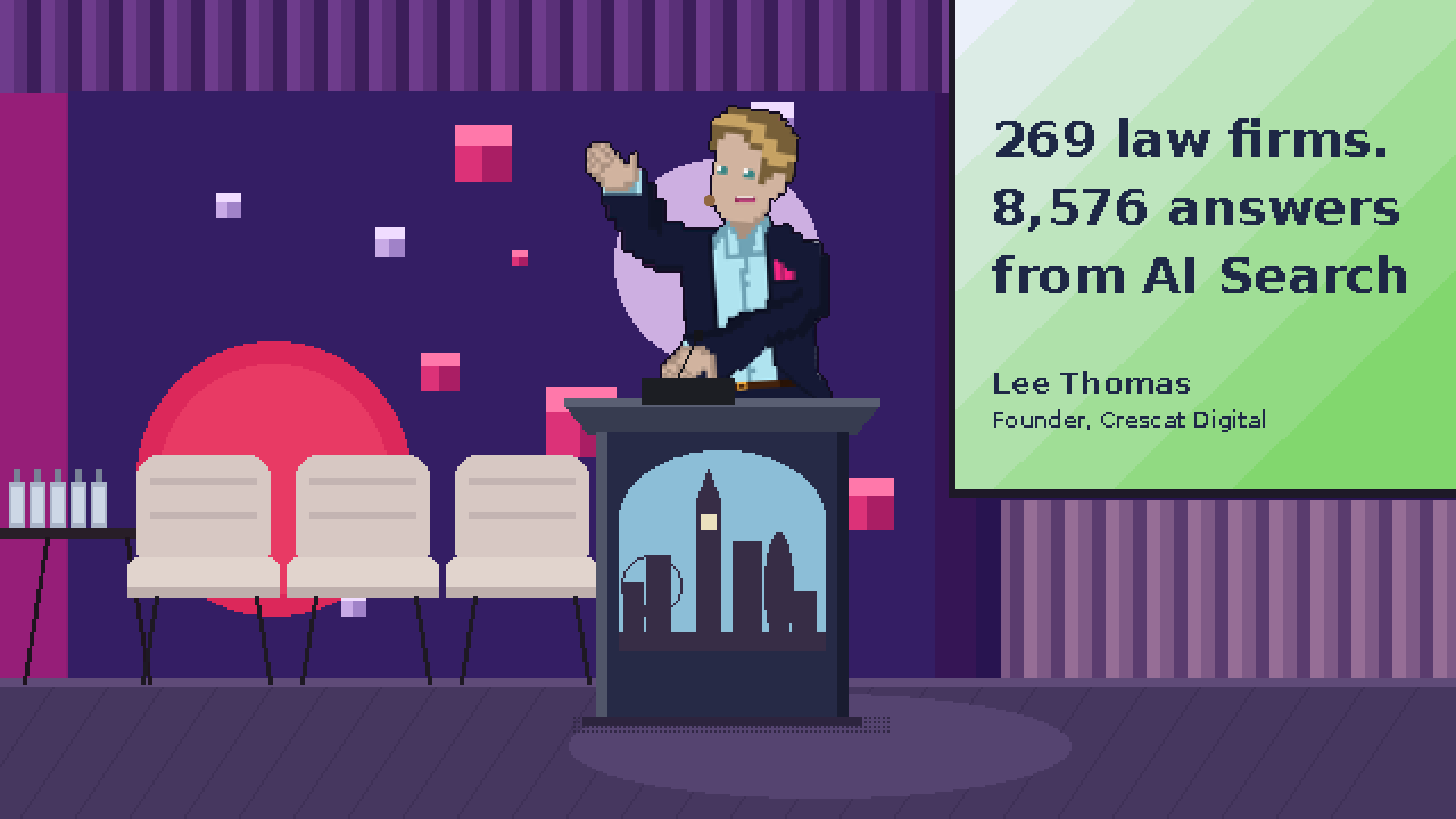
On Wednesday 7 October, Crescat Digital founder Lee Thomas unveiled The UK Law Firm AI Visibility Index 2026 on the operations stage at London Law Expo 2026. The Index tracks 269 UK law firms across 8,576 answers from ChatGPT, Claude, Gemini and Perplexity, and asks one simple question: is your firm named?
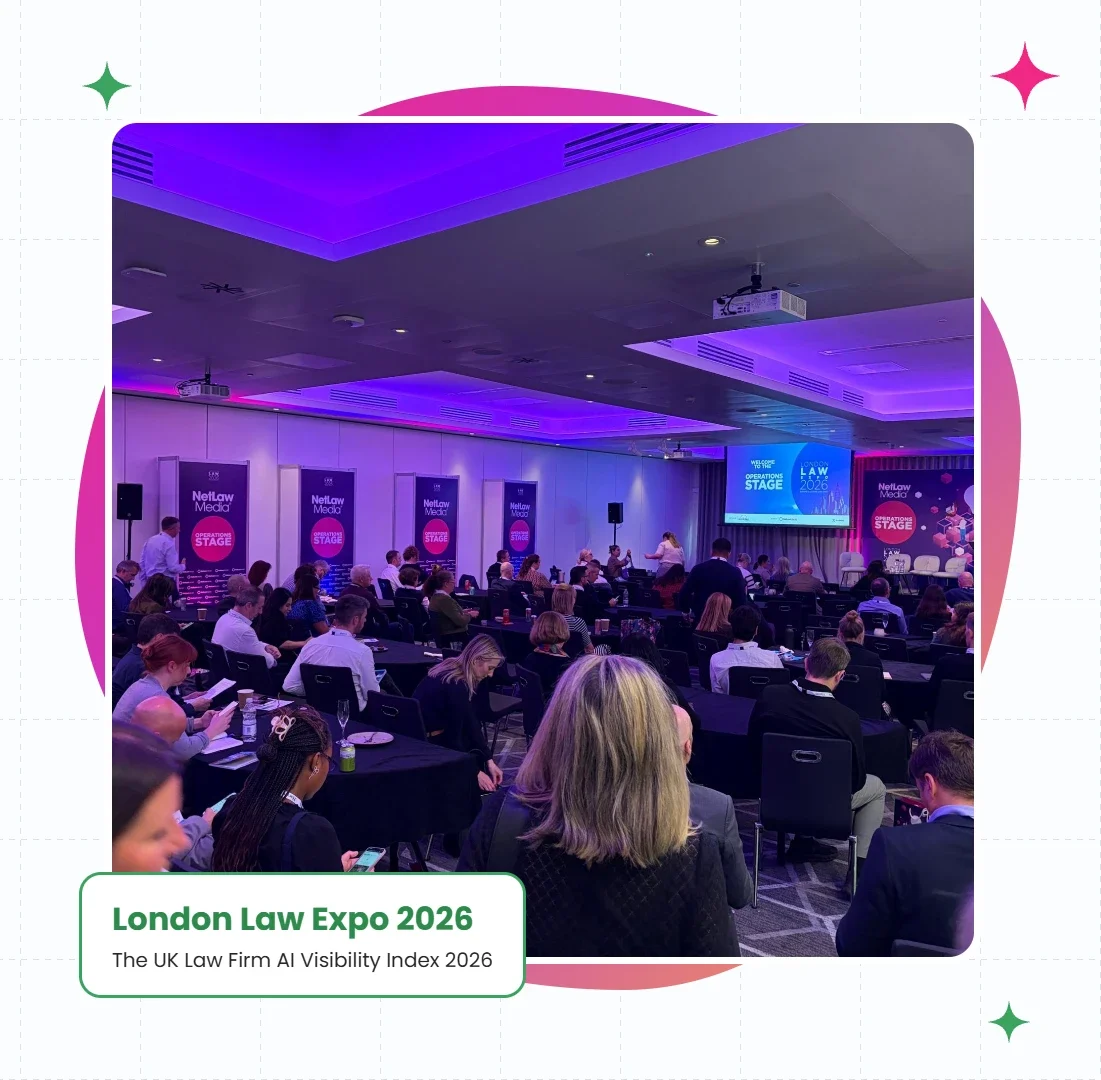
Hosted by Netlaw Media at the Convene building in London, the Expo brought together law firm leaders, operations teams and marketers. Lee’s session showed that the firms AI recommends depend heavily on who is asking, and that size alone does not decide who gets named.
One question, seven firms
Lee opened with a question a real client might type, word for word: “I need a employment law (unfair dismissal) solicitor in Leicester. Which firms should I contact? Please name specific local firms.”
ChatGPT named seven firms: Nelsons, Lawson-West, Freeths, Howes Percival, Smith Partnership, Shakespeare Martineau and Josiah Hincks. Across eight attempts at the same question, it named all seven in at least five answers. One of them, Lee told the room, was a Crescat client. He saved the reveal for the end.
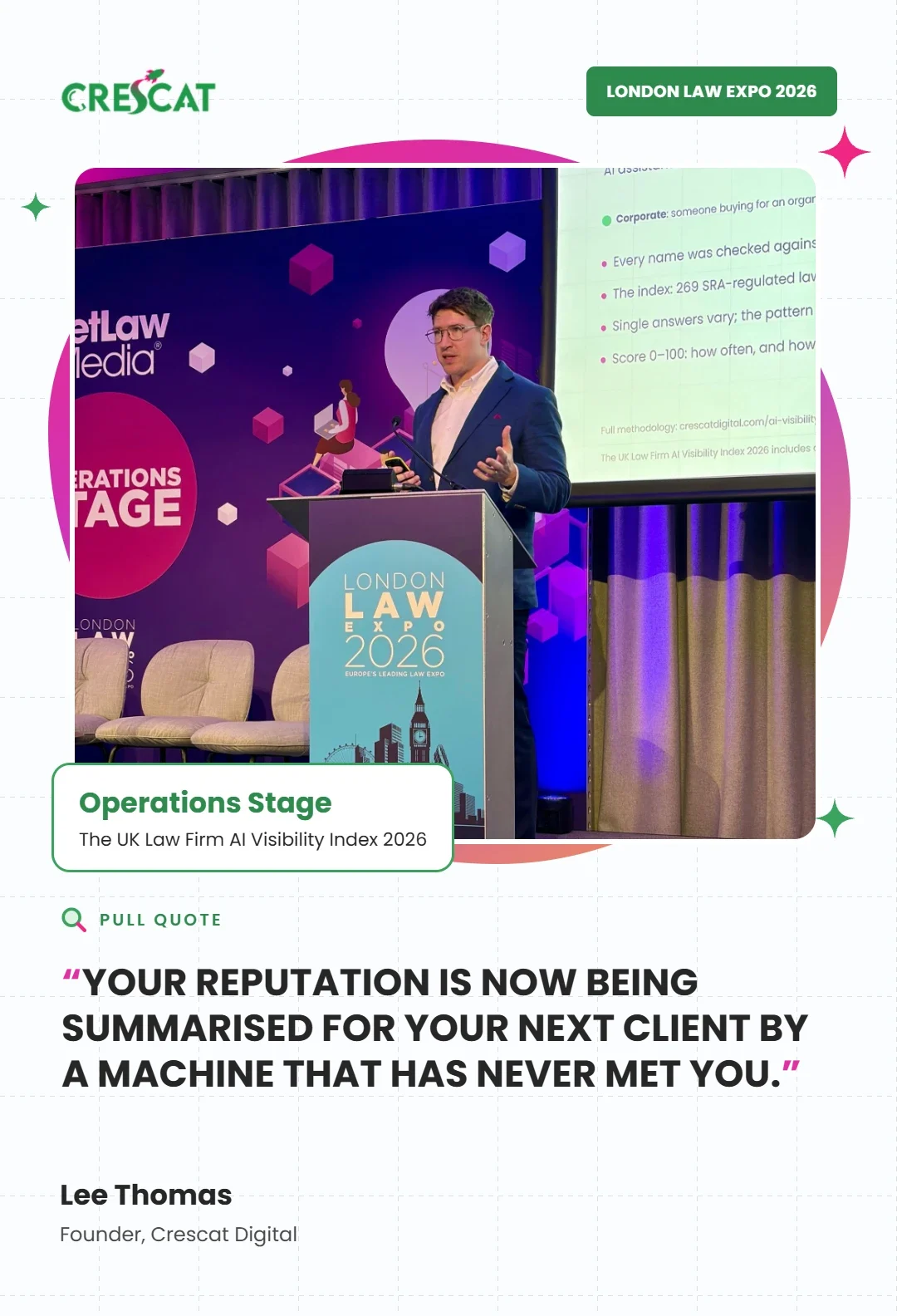
The point landed early: “Your reputation is now being summarised for your next client by a machine that has never met you.”
How the Index was built
Crescat asked four AI assistants 268 questions, eight times each, in September 2026. That produced 8,576 answers across 38 practice areas and 10 UK cities.
The questions were written the way three kinds of client actually ask:
- Corporate: someone buying legal services for an organisation (54% of questions).
- Consumer: a private client with no town named (31%).
- Local: a private client in one of 10 cities (15%).
The Index covers 269 SRA-regulated firms, mostly those with £15m+ filed turnover. Every firm name in every answer was checked against the SRA register; names that couldn’t be verified were left out, never guessed. Each firm gets a score from 0 to 100 based on how often, and how early, it is named. The score measures visibility, not quality.
The results are stable: 19 of the top 20 firms were the same in the early and late runs.
Who is named most
Nearly every firm in the Index is named somewhere: 253 of 269 appeared at least once. Far fewer are named often, and 117 firms appeared in fewer than 1 answer in 100.
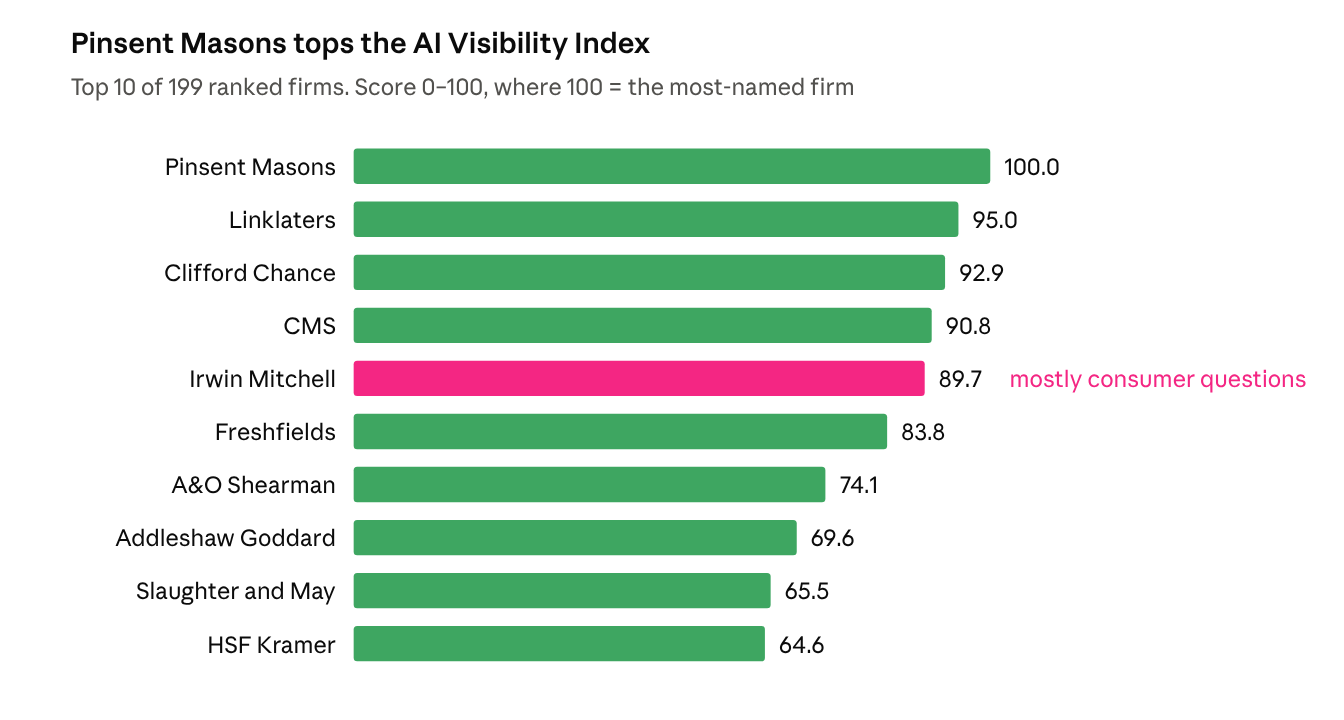
At the top, 17 of the 20 most-visible firms are named mostly on corporate questions. Pinsent Masons drew 2,289 of its 2,307 mentions from them. Irwin Mitchell is the standout exception, with 1,172 of its 1,505 mentions coming from consumer questions. Lee’s advice: read the table in groups, not places, as most neighbouring positions sit within the margin of error.
The question decides the winner
The biggest firms dominate when the AI is asked like a general counsel, and all but vanish when it is asked like a local client. Lee admitted this was what he got wrong: “I thought we had one client. We had a firm full of them.”
| Question type | Of the 25 largest firms, named in 1 in 10 answers or more | Of the 25 largest firms, never named | Mentions going to firms outside the Index |
|---|---|---|---|
| Corporate | 22 | 0 | 8.2% |
| Consumer | 2 | 2 | 26.8% |
| Local | 0 | 10 | 51.0% |
For local questions, half of all verified firm names belonged to firms too small to be in the Index. In total, the assistants named 1,030 verified firms outside it. For a local client, your competitor may well be the firm down the road, not the national brand.
Where the AI gets its answers
The sources behind each answer shift just as sharply as the firms named in it.
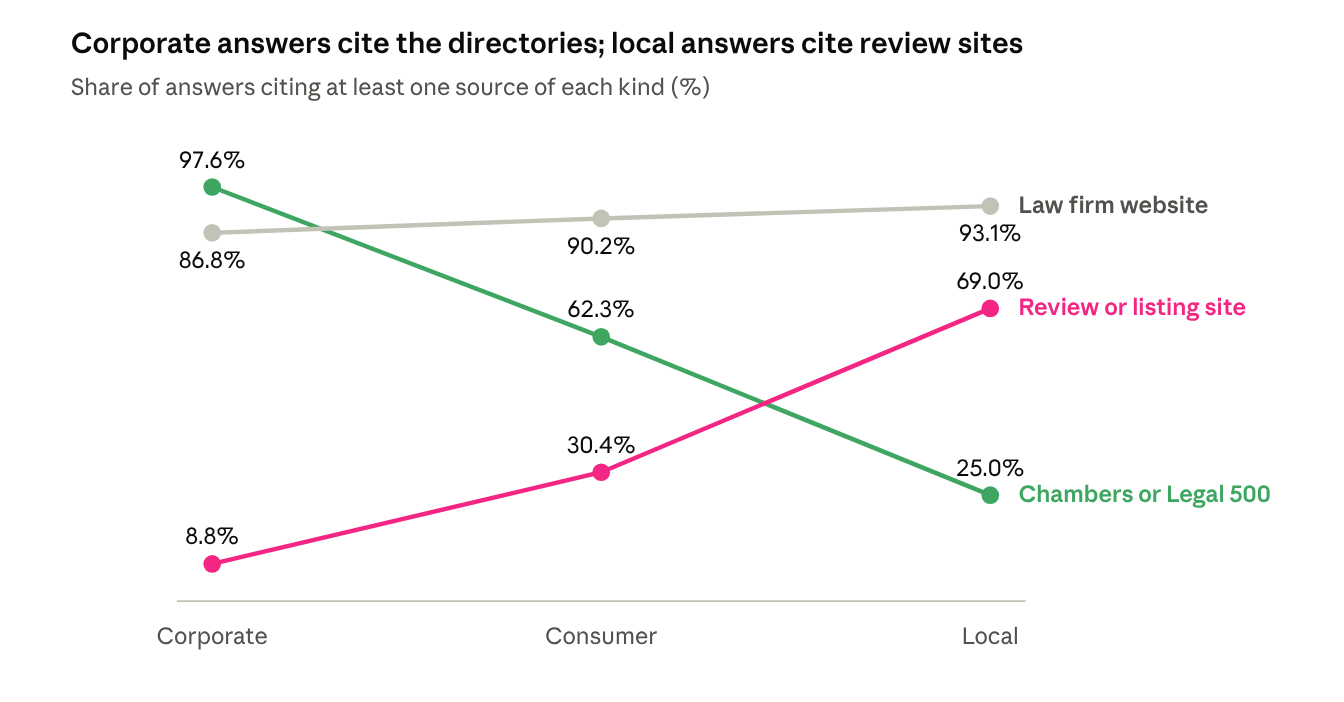
For local questions, the single most-cited site was ReviewSolicitors, in 474 of 960 local answers. ChatGPT leans on review sites far less than the others: they appeared in 19.4% of its local answers, against 95.0% for Claude and 92.5% for Perplexity. Throughout, the firm’s own website stays the most consistent source of all.
Size is not destiny
Four specialist firms are outranking firms ten times their size. Each is named far more often than its turnover would predict.
| Firm | Turnover | Size rank (of 255) | AI visibility rank (of 199) | Answers naming the firm | Top topics |
|---|---|---|---|---|---|
| Bindmans | £19.4m | 202nd | 33rd | 689 | Civil liberties, immigration |
| Duncan Lewis | £31.8m | 138th | 36th | 684 | Housing, civil liberties |
| Anthony Gold | £19.3m | 204th | 46th | 523 | Housing, Court of Protection |
| BCL Solicitors | £16.0m | 244th | 74th | 269 | Corporate crime, criminal defence |
When the AI names these firms in their top practice area, it leans on their own websites and on Chambers or Legal 500. BCL Solicitors was backed by a Chambers or Legal 500 citation in all 111 such answers. Duncan Lewis had its own website cited in 114 of 134.
Google is moving the same way
This isn’t just a chatbot story. When Crescat ran the same 268 questions through Google UK, 91.7% of searches that returned a results page showed an AI Overview. That rose to 99.5% for consumer questions and 94.0% for corporate ones, against 67.4% for local.
Google’s AI also names largely the same firms as the four assistants: 15 of the top 20 are shared, with a rank correlation of +0.93. Add the SparkToro finding that 69.5% of UK Google searches now end without a click, and the window for being found on a results page is narrowing.
The firm in Leicester
Lee closed the loop on his opening question. The Crescat client was Lawson West Solicitors.
Asked for an employment solicitor in Leicester, all four assistants named Lawson West in 31 of 32 answers: ChatGPT 8 of 8, Claude 8 of 8, Gemini 8 of 8 and Perplexity 7 of 8.
“The AI is picking us up and referring to our site.”
— Ashley Hunt, Director and Senior Employment Solicitor, Lawson West Solicitors
What this means for your firm
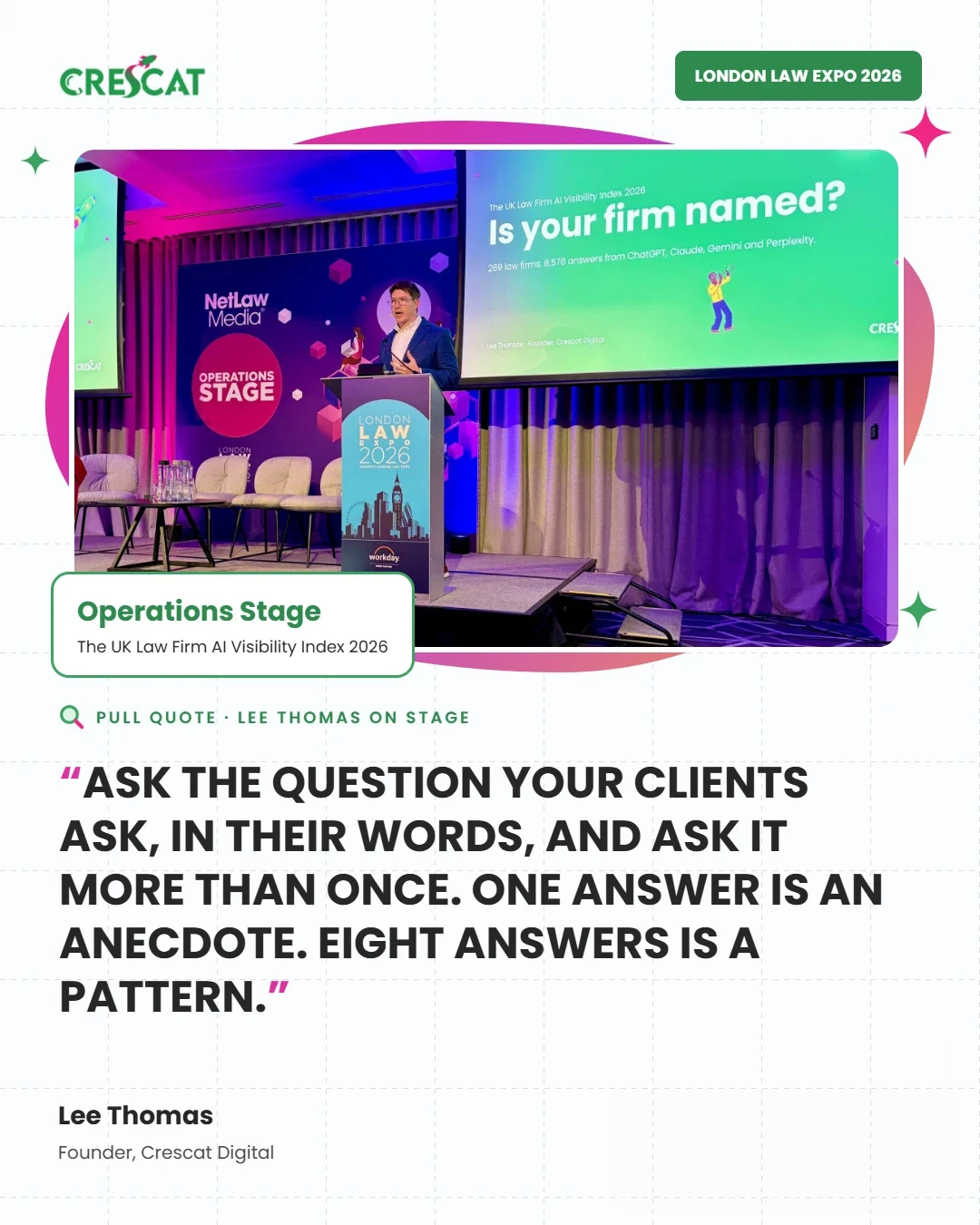
Lee’s advice was simple: ask what your clients ask, and ask it more than once. One answer is an anecdote. Eight answers is a pattern.
What matters depends on who your clients are:
| If you mainly serve… | What the Index shows | Where the AI looks |
|---|---|---|
| Businesses | Bigger firms are named more often, but not always | Chambers or Legal 500, cited in 97.6% of corporate answers |
| Consumers nationally | Much smaller firms can be named ahead of bigger ones | A mix of directories, review sites and firm websites |
| Local clients | Size barely predicts who is named; your competitor may be the firm down the road | Review and listing sites, cited in 69.0% of local answers |
Whatever the client type, a firm’s own website was cited in nearly nine answers in ten. Clear, accurate practice area content remains the foundation.
What the research does not show
Lee was clear about four limits:
- Why an assistant names a firm. The Index records what the AI says, not its reasons.
- That visibility causes growth. Visibility was measured in September 2026; turnover comes from accounts ending between June 2023 and April 2026.
- Scotland. The SRA register covers England and Wales, so most Scottish firms named in Glasgow and Edinburgh answers could not be verified or scored.
- What any one client sees. Answers vary, which is why every question was asked eight times.
Two Index firms are Crescat clients; every firm was scored by the same method.
Find out where your firm stands
Thank you to Netlaw Media for hosting London Law Expo 2026, and to everyone who joined Lee on the operations stage.
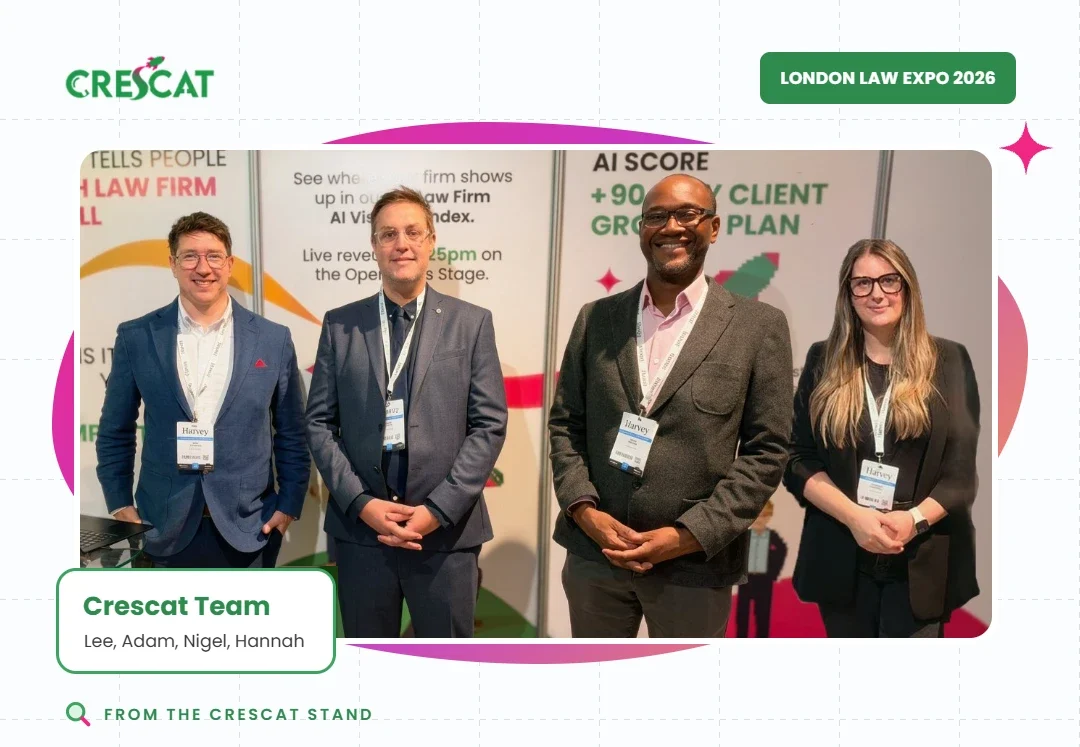
The full UK Law Firm AI Visibility Index 2026, including the complete rankings and methodology, is available at crescatdigital.com/ai-visibility-index. To find out what AI says about your firm, and which of the 268 questions name you, get in touch with the Crescat team.
The UK Law Firm AI Visibility Index 2026 includes data supplied by the Solicitors Regulation Authority.